Medicare Part A helps cover services such as:
- Inpatient hospital care
- Skilled nursing facility care under certain conditions
- Hospice care
- Some home health care

Medicare is the federal health insurance program primarily for people age 65 and older. It also provides coverage for some people under 65 with certain disabilities or health conditions.
Medicare has four basic parts: A, B, C and D.
Here's an easy way to begin thinking about them:
Medicare Part A helps cover services such as:
Think doctors and outpatient care.
Medicare Part B helps cover things such as:
Part B generally has a monthly premium, along with deductibles and cost sharing for certain services.
This is one of the most important concepts to understand.
When you hear the term Original Medicare, we're talking about Medicare Part A and Part B together.
Original Medicare provides broad access to care—you can generally see any doctor or use any hospital in the United States that accepts Medicare.
However, Original Medicare doesn't pay 100% of your healthcare costs. There is no "maximum out-of-pocket" protection. That's why you'll eventually need to think about how you want to handle the costs and coverage that Original Medicare leaves behind.
Here's where the alphabet can get a little confusing.
Medicare Advantage, also known as Part C, is another way to receive your Medicare benefits.
Medicare Advantage plans are offered by private insurance companies approved by Medicare. You must have Parts A and B to join a Medicare Advantage plan, but the private plan becomes the way you receive your Medicare-covered healthcare services.
These plans:
Plans and benefits vary, so understanding the details matters.
Think D for drugs.
Medicare Part D helps cover prescription medications and is provided by private insurance companies approved by Medicare.
You may receive Part D coverage through:
Each Part D plan has its own formulary, or list of covered medications. Plans may also place medications into different tiers, which can affect what you pay.
That's why choosing a drug plan should involve more than simply looking for the lowest monthly premium. Your specific medications, dosages and preferred pharmacy can all make a difference.
Here's an important distinction:
Medigap is NOT another “Part” of Medicare.
Medicare Supplement Insurance — commonly called Medigap — is private insurance designed to work alongside Original Medicare.
It can help pay some of the deductibles, coinsurance and other out-of-pocket costs that Original Medicare doesn't pay.
If you choose the Original Medicare route, your coverage might look something like this:
Part A + Part B + Medigap + Part D
Medigap plans generally allow you to receive care from any healthcare provider nationwide who accepts Medicare.
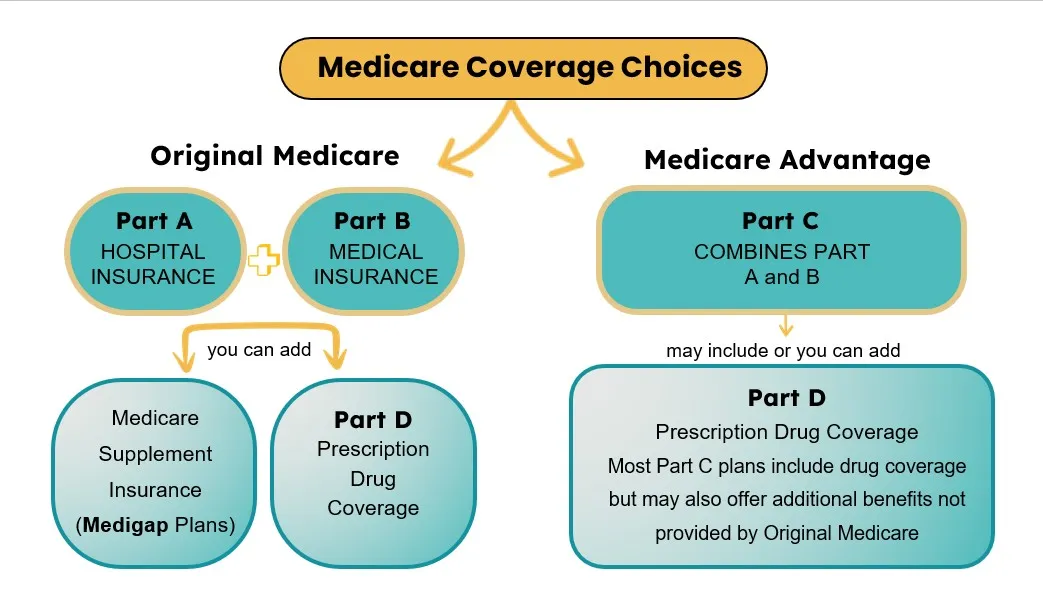
Once you understand Parts A, B, C and D, the bigger picture starts to become clearer.
With Original Medicare, you receive your Medicare benefits through Parts A and B. You may then add Medicare Supplement Insurance and Part D prescription drug coverage.
With Medicare Advantage, also known as Part C, you receive your Medicare benefits through a private Medicare approved insurance company. These plans usually include Part D prescription drug coverage.
Neither path is automatically right or wrong.
Your healthcare needs, doctors, prescriptions, budget, travel habits and personal preferences can all play a role in determining which direction may be a better fit for you.
TRUSTED MEDICARE RESOURCES
Okay, maybe the retired teacher in me can't completely give up assigning homework!
When you're learning about Medicare, always make sure you're getting information from reliable sources. Two of the very best are the official federal government Medicare resources:
Medicare.gov
Compare plans, learn about coverage and costs, find providers and explore Medicare benefits.
CMS.gov
The Centers for Medicare & Medicaid Services administers Medicare and provides official Medicare information, educational materials and resources.
And, of course, you can always ask me.